
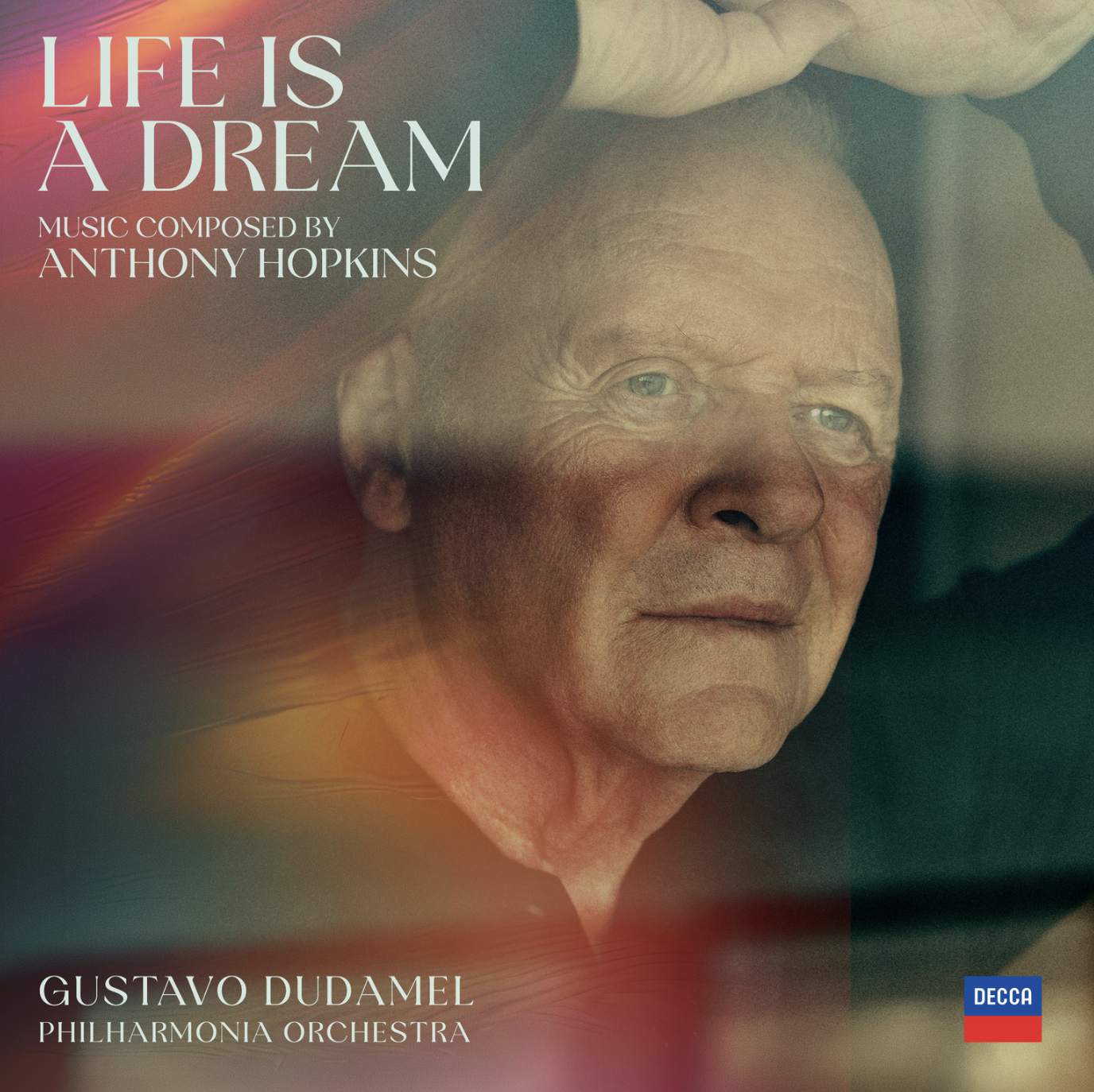
How many actors can you think of that have also written songs and classical music compositions? The dabblers include Clint Eastwood, Lady Gaga and the late, greats Dudley Moore and Dolly Parton. But, Welsh actor Anthony Hopkins has been moonlighting in the classical genre since the early days of his education that began with music and dramatic art studies in Cardiff and London. He became one of the most celebrated actors of theatre, television and film. Now 88 years-young, his award winning roles include The Lion in Winter (1968), The Silence of the Lambs (1991) and Mary (Netflix, 2024). In 2012 he released the album Composer and his latest offering is Life is a Dream with the Philharmonia Orchestra under Gustavo Dudamel with collaboration from pianist Sergio Tiempo, cellist Gregorio Nieto, The Bach Choir and Boy Choristers of Winchester Cathedral (Decca, 2026).
This album is brimming with nostalgia as the pieces derive inspiration from Hopkin’s upbringing in the Welsh community where he grew up and as such, he takes us on a musical journey through moments of culture and countryside associated with his life. Hopkin’s writing is as unique as his acting, as he creates a style of expressive orchestration that is padded with touches of mystery and flowing lyricism from winds, especially the flute in Farewell My Love and Margam, where Tiempo delivers a delicate sentimentality to the melodic interludes. Stella Aria, dedicated to his wife, provides more atmospheric intimacy with Nieto’s velvety tone front and center.
Hopkins revisits lifework moments in And the Waltz Goes On, which he wrote in 1963 during a stint at the Liverpool Playhouse, and the bold My Fatherland which was motivated by youthful radio listening to music of Ralph Vaughn Williams and Frederick Delius. The Philharmonia’s melodic richness with Dudamel is on display in 1947: Suite for Solo Piano and Orchestra, based on Hopkin’s memories of what he describes in the album booklet as a sizzling hot summer in Wales (Global warming in 1947?). Of the work’s second movement, Bracken Road, Hopkins writes, “The bluesy, languid tune is inspired by the slow ballads of the Harry James Orchestra and Jackie Gleason,” of which the sultry palette provides an ideal match for Tiempo’s nuanced playing.
The album ends with Two Pieces for Orchestra, which Hopkins composed in 2024 using W. Somerset Maugham’s short, dark fable “Appointment in Samarra” as a backdrop. The Philharmonia, choirs and cello interludes come together in sonic grandeur, led by Dudamel, melding percussion and strings in an exotic soundscape that could serve as a film score of some thriller. The tingling hue of Samsara, the work’s second movement evokes (without comparison) a sense of detached austerity associated with Ludwig Göransson’s brilliantly haunting theme Odysseus from Odyssey (2026) and Ennio Morricone’s soundtrack for the classic The Good, the Bad and the Ugly (1966).
Anthony Hopkins comments about the Life is a Dream album. “Music was my first desire, my first wish. I’ve been composing music all my life. Some of these pieces have lived with me for decades and I still find myself returning to them.” (NBC News, July, 2026). We look forward to hearing more of his musical creations, of which might include a newly composed tidbit for violin, cello or piano.