
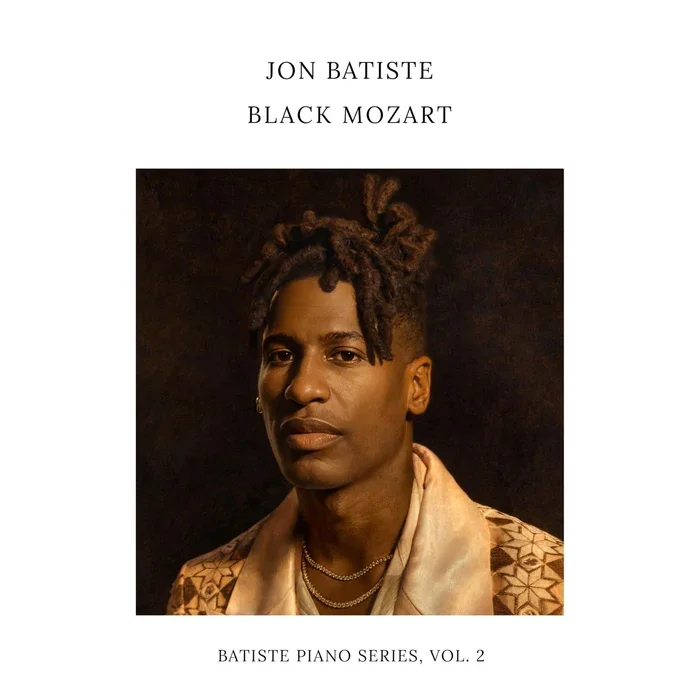
The Batiste Piano Series is comprised of four volumes: Beethoven Blues (Verve, 2024) and three recently released albums: Black Mozart, Monk Meditations and Monk Movements – inspired by pieces of jazz legend Thelonious Monk (Verve, 2026). In Beethoven Blues, the first installment, Jon Batiste gives some of Beethoven’s familiar works a traditional and progressive redo, especially in the brilliant adaptation 5th Symphony in Congo Square – a must hear. Batiste draws on his Louisiana roots that include classical piano and jazz as well as studies at The Juilliard School to meld a unique soundscape in Black Mozart. What makes Batiste’s work so interesting is how he uses a variety of genres and characteristics to reset then and now pieces with fresh ideas. In that sense, his work is always evolving.
In this album, he taps into familiarity by spinning pieces of Wolfgang Amadeus Mozart with improvisational creativity, something that was also attributed to Mozart during his performances. In fact, when this composer premiered new piano concertos, he allegedly wrote orchestra parts in the score but omitted much of the piano entry (which was penciled in at a later time) because he, the ultimate child prodigy let loose with incredible feats of improvisation, especially in cadenza-like sections.
Fast forward to the 21st century where Batiste melds tradition with upbeat punch in drawing out rhythmic twists and riffs to a sensuous sounding Alla Blues (from Rondo alla Turca) and Country Zart. He adds some serene modulations to Twinkle (from Ah vous dirai-je, Maman or Twinkle, Twinkle Little Star piano variations). But just when you think he only receives shout-outs for film scoring as recipient of the big four awards, Academy, Grammy, Golden Globe and BAFTA, he shows off pianistic skills in Facile-Batiste, where passages from the first movement of piano sonata in C Major, K. 545 are played with pearly facility. Gospel Andante is another arrangement where his velvety touch sings out the hummable tune from piano concerto K. 467 (nicknamed Elvira Madigan after the 1967 film score) in the right hand which is supported by syncopated strumming beats in the left hand accompaniment.
In the album booklet, Batiste writes, “I reimagined Mozart Black in the tradition of Alvin Batiste {a former mentor}, imbuing it with influences from jazz, rags, stride, blues, stomps but still maintaining its core essence of modern classical music.” This is the outcome of Molto and Molto in Cayo Hueso, based on the opening theme from Mozart’s well-known symphony K. 550 where the second Molto arrangement unfolds like an improvisatory tour de force, blending Caribbean-style reggae, thunderous keyboard antics and steel pans inflections with treads of Mozart’s own writing. It’s a brilliant hybrid that infuses music of our time with roots from a classic era.
In the Monk Meditations album, Batiste writes in the booklet, “In this album I explore music composed by or inspired by Thelonious Monk….Monk’s music makes my brain and my soul feel aligned in a very special way…Monk is still underrated. He is one of the greatest of all time in any form or field.” For those who might be unfamiliar with Monk’s compositional style, this album highlights his sophisticated writing in pieces like Reflections, Crepuscule With Nellie and Monk’s Mood which contain complex harmonic and technical snippets that could adorn works of Debussy or Messiaen. He remains a rather esoteric figure in the world of jazz but no less engaging, especially when his music is revisited by Batiste – of which Midnight Movement (based on the original Round Midnight) incorporates a hue of minimalist patterns that create a mesmerizing effect. Black Mozart and Monk Meditations offer a totally intriguing listening experience that make you want to vibe to the music.