
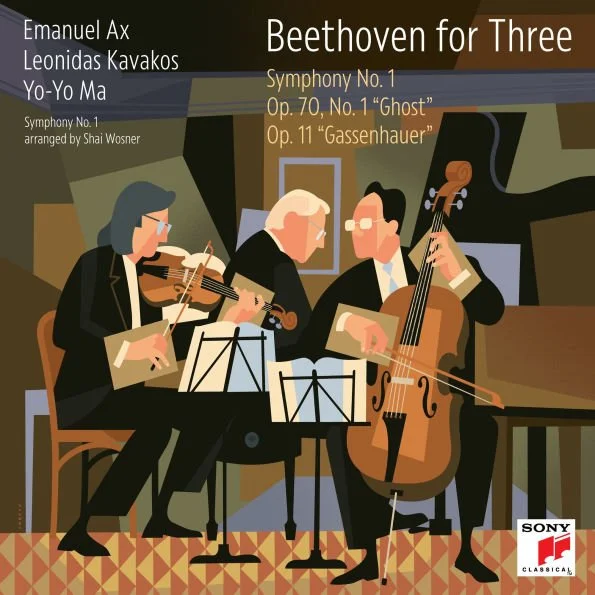
Just when you thought only Liszt did transcriptions of Beethoven symphonies along comes pianist Shai Wosner, who teaches at The Juilliard School, with arrangements of selected symphonies that are included in Beethoven for Three albums featuring blockbuster performers Emanuel Ax, Yo-Yo Ma and Leonidas Kavakos. The four recordings released between 2022-2025 offer piano trios Op. 1, No.3, Op.11, Op.70, No. 1, Op. 97 and transcribed symphonies nos.1,2,4,5 and 6, written between 1800-1808. (Sony Classical.) This review offers impressions of the entire series.
It’s ok to call a transcription hybrid if it reflects a composer’s intent. Wosner’s downsized concept is chock full of imagination in making the most out of Beethoven’s luxuriant orchestration. Streamlined scoring seems to work quite well in earlier symphonies where piano prominence propels sparkling fingerwork in number two and fiery bravura of the fourth’s outer movement that resonates like a string ensemble. Wosner tweaks symphonies five and six, the ‘Pastorale’ into a mélange of sonic textures that interplay between Kavakos, Ma and Ax. The piano features prominently to often initiate rhythmic motives and imitation of Beethoven’s use of winds and brass, as in the fifth’s iconic opening.
Wosner’s versions of the fifth and sixth symphonies is a whodunit musical adventure. The ‘Pastorale’s’ Allegro-The Storm movement is fluttering with piano tremolos and bowing effects and the fifth symphony takes a musical ride on the wild side within a harmonic transformation that make the Finale’s themes sound familiar yet experimentally conceived with atmospheric glissandi, pizzicati, string strumming - probably not something a purist might bond with. But the Wosner version contains stylistically traditional and progressive moments that keep you aesthetically on the edge of a musical seat. After all, Beethoven often took a learn-the-rules-then-break-some-of-them approach to his writing, and other attributes.
It’s well known that Ax, Kavakos and Ma are consummate chamber musicians, especially the Ax-Ma collaborations, and their interpretation of the ‘Archduke’ Trio is gold standard for its expansion and seasoned maturity where Ax and inspired collaborators draw out a sweet pathos in the Andante Cantabile and give an otherworldly texture to the ‘Ghost’ Trio’s second movement. The ‘Gassenhauer’ Trio is bounding with lilting, melding dexterity. The Beethoven for Three albums are vintage Ax, Ma and Kavakos.