
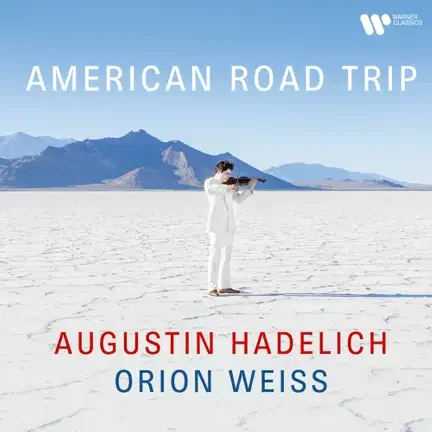
On July 4, 1776 the Second Continental Congress approved the Declaration of Independence from Great Britain, which was officially signed on August 2 of that year by members of the thirteen colonies that included Thomas Jefferson, Samuel Adams, John Hancock and Benjamin Franklin. America will celebrate this 250 anniversary with musical events that feature American composers through the years, and not just John Philip Sousa – but those in jazz, pop, bluegrass and classical genres. American Road Trip is Augustin Hadelich’s latest release that offers a patchwork of musical Americana in pieces from Amy Beach to John Adams – with essential and quintessential collaboration from Orion Weiss, when required, who makes a keyboard sound very orchestral and vibrant. (Warner Classics).
A really cool thing about this recording is the way Hadelich captures the stylistic personality of each composer which results in classy interpretations. These pieces offer wonderful perks to his programs that include Brahms, Tchaikovsky, Barber and Adès. (Yet another reason why this globally recognized violinist is Artist in Residence with the Boston Symphony for the 2025-2026 season and on the Yale School of Music faculty). The album contains miniatures that reflect a sugary sentimentality in Beach’s Romance Op. 23 for violin and piano, Bernstein-Penaforte Somewhere from West Side Story Suite and the Ponce-Heifetz Estrellita – which Hadelich draws out with sweet toned nuances.
But there are also plenty of virtuosic bijou works that Hadelich plays with fiery, fleet fingered articulation such as some earthy bluegrass fiddle-flavored strumming in Coleridge-Taylor Perkinson’s Louisiana Blues Strut: A Cakewalk, pizzicato flourishes of William Kroll’s Banjo and Fiddle, Hadelich’s arrangement of Wild Fiddler’s Rag, a chic version of Aaron Copland’s Hoe-Down from Rodeo and Eddie South’s blues infused Black Gypsy. Daniel Bernard Roumain, the creative contemporary composer of works such as Voodoo Violin Concerto and We Shall Not Be Moved is also represented in Filter, of which the work asks for and Hadelich produces a stunning mélange of continuous bowing flutter that is buzzing with resonance. It’s a work and an interpretation to remember.
The album also includes several mid-sized offerings by Charles Ives, Stephen Hartke and John Adams, of which this composer’s Road Movies for violin and piano is among his many works that conjures up a unique palette of rhythmic punch, in this case a flurry of long, sequential twanging - which Hadelich plays with fearless, pinpoint abandon. Of course it wouldn’t be an American musical road trip without Ives, who doubled as insurance agent, estate planner and composer of many works, of which his third symphony received a Pulitzer Prize for Music.
Expect the unexpected in his music and so it goes with his Violin Sonata No. 4: Children’s Day at the Camp Meeting, written in 1916 with its magical Largo-Allegro that seems like new world experimentalism peppered with hints of old world Second Viennese School exoticism, interspersed with threads of the hymn Yes, Jesus Loves Me – of which Hadelich and Weiss perform with total command and aesthetic touch. A similar effect is heard in Hartke’s six movement Netsuke for violin and piano. In case you are not familiar with Hartke’s works, he received a Grammy for Best Contemporary Classical Composition in 2013 and is Chair of the composition department at Oberlin Conservatory of Music. Netsuke is the name of Japanese miniature carvings worn in a kimono sash with each movement having a rather mysterious title that evokes the persona of the people who wear these.
A shout out to Hartke for producing one of the most intriguing compositions of our time for violin and piano that melds the tonal tonality of a koto, taiko and more – with movements three (Tanuki playing the samisen) and six (Jewel of Wisdom with mountain pavilions) taking us into a musical kaleidoscope of otherworldly sonic effects. Hadelich and Weiss make it happen.
American Road Trip is a recording to be listened to on the Fourth of July or anytime, including your car’s CD changer while driving on a highway, byway, freeway – perhaps to the Ojai Music Festival (June 11-14).