
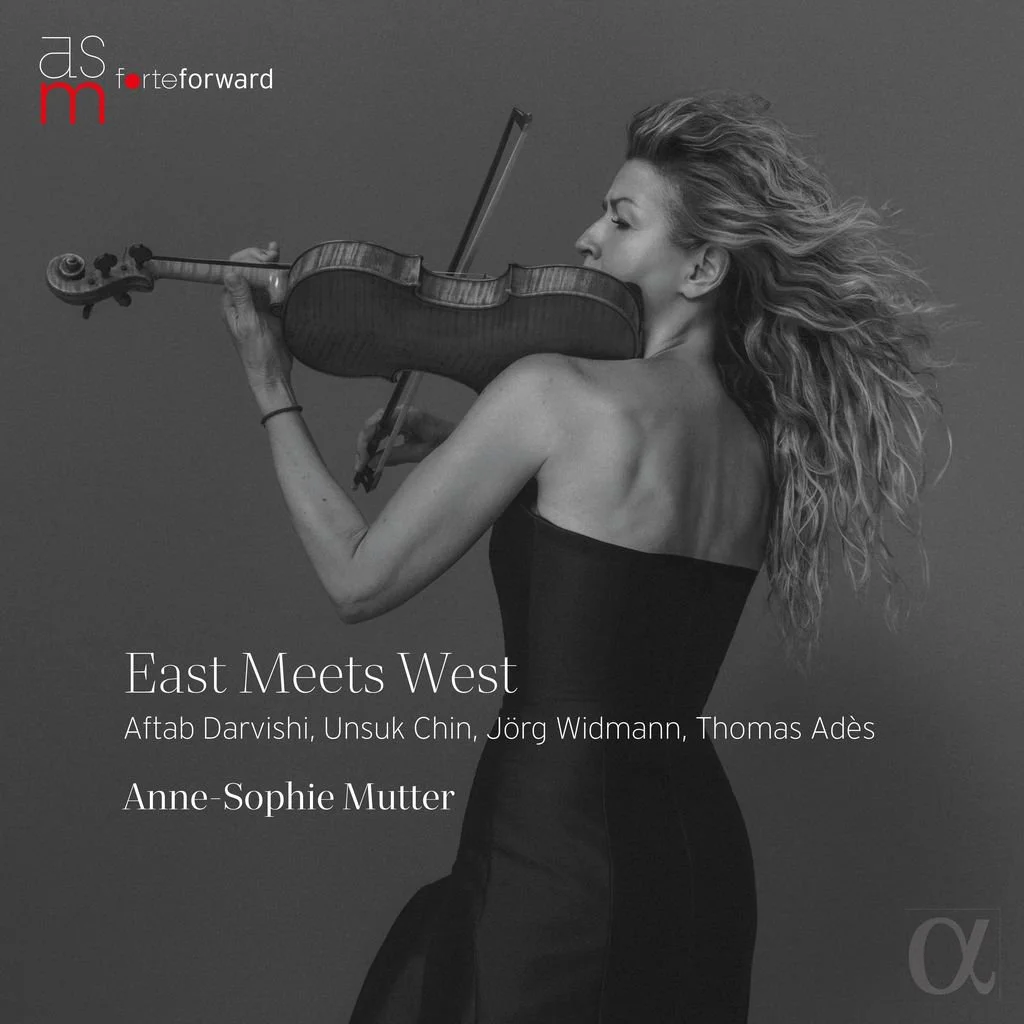
Anne-Sophie Mutter is celebrating 50 years on the concert stage with the release of East Meets West, an inaugural album on the Alpha Classics label that launches her ASM Forte Forward project promoting works by composers of our time and written for her. There is more to come in August as the label plans to release the next in a series, American Tunes #1 that will include works by André Previn and Sebastian Currier.
As a former child prodigy turned consummate artist with enduring and endearing star power, Mutter’s repertoire spans the music globe in performance and recordings that include Beethoven’s complete sonatas for piano and violin, Gubaidulina violin concerto and John Williams second violin concerto - as well as supporting charities through performance and a foundation in her name to provide scholarships for aspiring string players.
East Meets West is a metaphorical description of what the album represents, which is an intriguing selection of works by composers with roots from Iran (Likoo for violin solo by Aftab Darvishi), South Korea (Gran Cadenza for two violins by Unsuk Chin), Germany (Studie über Beethoven by Jörg Widmann) and England (Air-Homage to Sibelius for violin and orchestra by Thomas Adès). Of course the works, written with Mutter in mind, are blazing with virtuosic passages and palette of sonic nuances as in Likoo, which is inspired by folk poetry from Iranian desert culture and Gran Cadenza of which Chin uses the fingerboard to project a springboard of effects like pizzicato, harmonics and flying arpeggios for Mutter and Nancy Zhou.
Yet, both these works are harmonically constructed, devoid of dissonance and offer a progressive yet mostly traditional approach evoking an old school chaconne – all of which bonds with Mutter’s technical wizardry and mission to promote refreshing modern compositions. There is more to come in Widmann’s concept of Beethoven’s string quartet no. 6, superbly projected by Mutter and seasoned players Ye-Eun Choi (violin), Muriel Razavi (viola) and Pablo Ferrández (cello).The work is based on four movements of this composer’s string quartet Op. 18, No. 6 which he wrote in 1800 around the same time as the first piano concerto and first symphony.
There is always a sense of the unexpected in Widmann’s music and a touch of brilliance in Studie über Beethoven, a work searching for a center of tonal gravity that is adorned with a soundscape of alternating pitch fluctuations. No worries if you don’t quite recognize Beethoven’s original score because that’s what present-day quality musical experimentalism is supposed to be all about. This also applies to Adès and his provoking operas The Tempest and The Exterminating Angel. In Air-Homage to Sibelius, led by Adès with the London Symphony, the piece unfolds in unending layers of rolling orchestration that include winds, strings, gongs and chimes to sustain Mutter’s mellifluous tone floating above it all with song-like simplicity. The effect is mesmerizing and adds another dimension to the East Meets West release and Anne-Sophie Mutter’s artistry.