
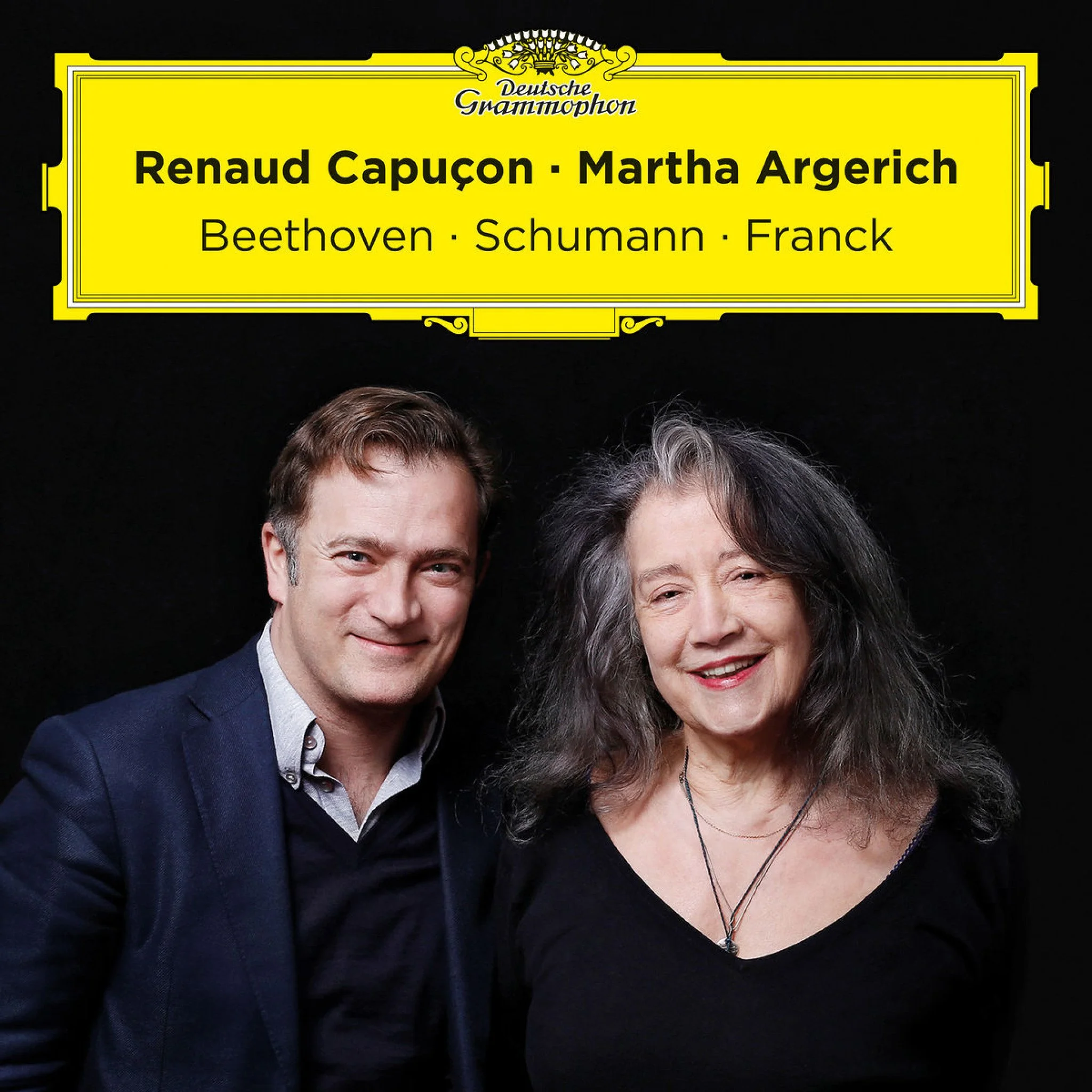
Martha Argerich is my pianistic idol, having interviewed her twice, in Zürich and Los Angeles. Reportage describes her as a force of nature, and of course one of the greatest pianists ever. Her global career as soloist, which ascended after winning the International Chopin Piano Competition in Warsaw at the age of twenty-four, also includes a devotion to chamber music, of which she has performed and recorded with leading string players such as Maxim Vengerov, Mischa Miasky, Gidon Kremer, Gautier Capuҫon and his brother Renaud Capuҫon – of which this album features a live recording with Renaud Capuҫon and Argerich in sonatas for violin and piano by Beethoven, Schumann and Franck, performed at Festival de Pâques d’Aix-en-Provence, France (Deutsche Grammophon, 2022). In fact, the Capuҫon brothers with Argerich will be performing Beethoven’s Triple Concerto at this festival on March 27 of next year, should you be in the area.
Capuҫon, who is a fine soloist, quintessential chamber musician and Artistic Director of the Easter Festival in Aix-en-Provence says in the album booklet, “But Martha is one of the only ones who gives me the feeling of being beyond free. You are free, but then there is a degree further – and that’s what we have in the “Kreutzer” Sonata.” You have probably heard Beethoven’s signature sonata, Op. 47, the so-called Kreutzer played before. But not like this performance. Argerich and Capuҫon deliver an interpretation that is inspired and loaded with mellifluous emotionalism and virtuosity right from the dreamy opening, where Argerich sets the stage with lingering sonority, which is taken up by Capuҫon’s nuanced and sweet-toned playing.
Argerich’s sweeping phrasing in the work’s Andante con variazioni breathes a special malleability and forward drive into Capucon’s delicatissimo fingerwork. The stylistic implications of this performance are, as Capuҫon states, quasi-conventional and as such, the Finale is peppered with a sizzling dose of footloose and fancy-free panache. Capuҫon’s booklet statement says it best: “…whenever we play the “Kreutzer” Sonata together, it feels like fireworks.”
Of Franck’s sonata, for violin and piano, Capuҫon says, “On stage we have huge, huge fun. I think that in this recording you can hear it.” There are a number of fine recordings of this sonata, which includes classics with Zino Francescatti and Robert Casadeus and Yehudi Menuhin and his sister Hephzibah Menuhin. This performance abounds with refined, elegant violin playing throughout, but it’s also a piece where Argerich shows her incredible sense of artistic imagination and technical savvy. The opening movement unfolds in an impressionistic palette of colors that evokes visual images of Claude Monet’s garden themed paintings of Giverny. The Allegro becomes a tsunami of seamless rhapsodic spontaneity that leaves you breathless. The Recitativo-Fantasia has the hue of a serene dreamlike caress, and the Allegretto poco mosso, with its beloved melody contains a collaborative sensitivity where waves of otherworldly harmonic and pyrotechnical effects, fueled by Argerichs’ luscious playing, transform the work into a recreation of a creation. This interpretation sets the Capuҫon-Argerich team apart.
Also included on the disc is Schumann’s sonata for violin and piano, Op. 105, one of three sonatas he wrote for this idiom, of which his esoteric violin concerto followed a year later. The identifiable Schumanesque interludes are treated with a poetic lilt and pinpoint articulation in the Lebhaft movement, making the work a more programmable offering, although of a different quality than this composer’s other compositions involving violin and piano, such as Piano Quintet, Op. 44 and Piano Quartet, Op. 47.
While studio recordings are a great way to capture the past and present, live performance offers an element of excitement, especially if recorded onstage. This album with Renaud Capuҫon and Martha Argerich captures an awesome musical moment that can be enjoyed without having been there.