
2026 Music Academy of the West Summer Music Festival and School
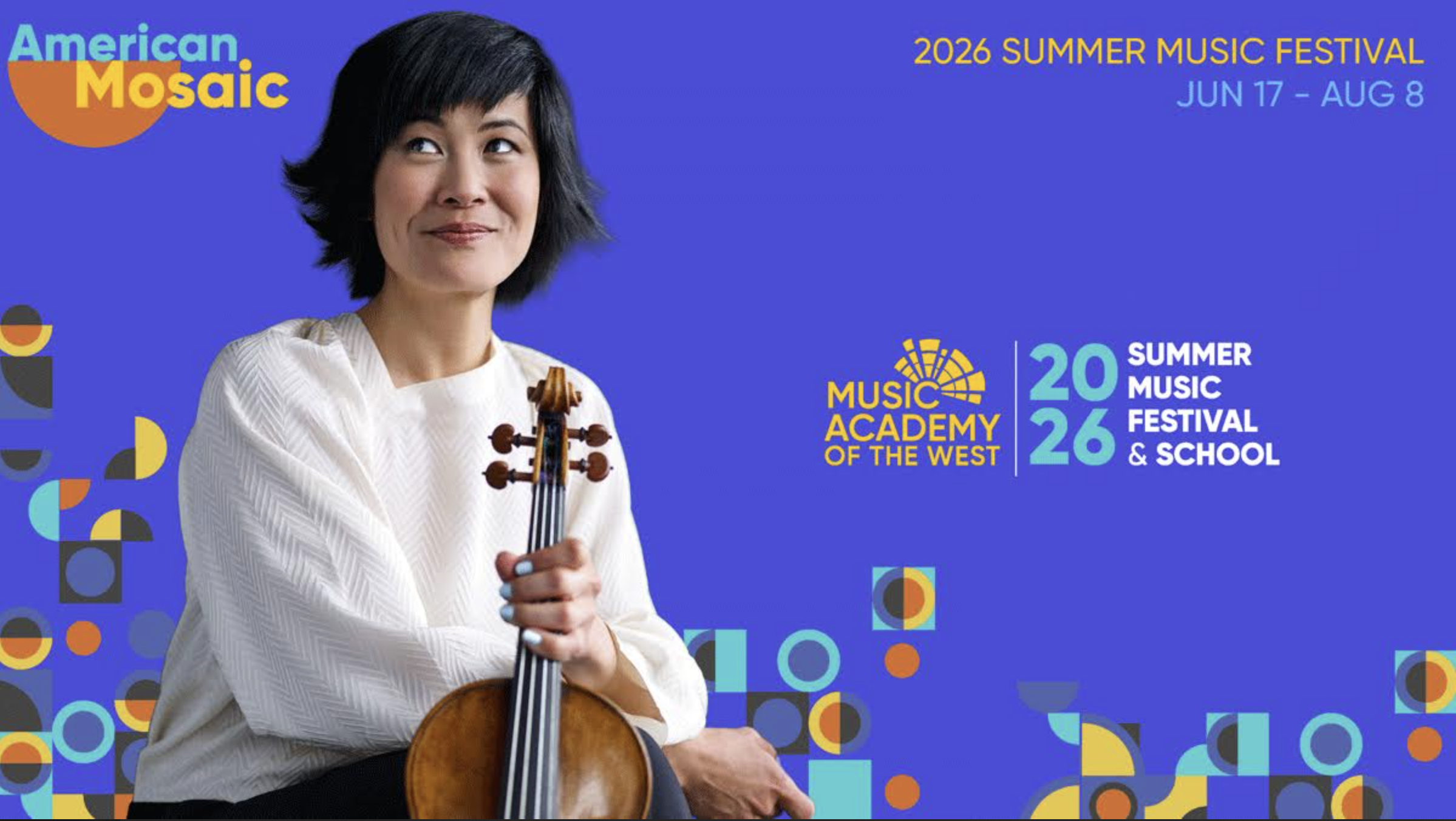
An oasis of inspiration since 1947, Music Academy of the West Summer Music Festival and School just kicked off its American Mosaic themed assortment of concerts, masterclasses and aesthetically conceived events that will run until August 8. This year’s prestigious lineup includes members of the Academy’s teaching and guest artists faculty such as Stephanie Blythe, Jeremy Denk, Miguel Harth-Bedoya, Missy Mazzoli and Bing Wang. Miroirs CA reviews four offerings that took place during the first week that featured concerts and masterclasses of Zlatomir Fung and pianist/conductor Jeffrey Kahane at the Music Academy’s idyllic Montecito campus and neighboring downtown Santa Barbara.
This year the Academy debuts High School Intensive, a two week program that highlights pre-college conducting, string and piano students in masterclasses, of which the opening week included cello and piano masterclasses coached by Zlatomir Fung and Jeffrey Kahane – that gave listeners an opportunity to hear their teaching philosophy in interaction with talented players. In addition to their global careers, Fung is on the faculty of The Juilliard School and Kahane of the Thornton School of Music at University of Southern California.
Both Kahane and Fung seemed to relate to students in a laid-back yet articulate manner as might occur during private lessons in a studio. Three students performed in the High School Intensive piano masterclass, of which Kahane shared tips about posture, technique and sound production in pieces like Ravel’s Une barque sur l’océan and Beethoven’s piano sonata Op. 10, No. 3. These students responded well to his pro-active advisement as did the foursome in the High School Intensive cello masterclass, where Fung tapped into students potential by zeroing in on interpretative elements of works by Cassadó and Elgar, which achieved some impressive results.
Apropos of his masterclass, Fung comments on his approach to teaching in conversation with the Miroirs CA Editor. “We are fortunate that the students who come to study at Juilliard are already at a very accomplished level of musicianship and craftsmanship. However, each student I work with has different needs and a different purpose. My ultimate goal as a teacher is helping each student unlock enough self-awareness to find the most fulfilling path possible.”
Fung says that many variables exist in a student’s playing and personality, and that self-knowledge helps increase understanding of one’s work. “For example, a student who struggles with nerves in their solo playing might discover a passion for playing in a pit orchestra; a very goal-oriented student might improve more rapidly under the pressure of competition preparation; a student might find they have particular gift for bringing out vivid dimensions in new music. The values I try to instill in my students are curiosity and introspection, which in my experience always reveal the answers.”
Fung’s recital on June 18 at Hahn Hall also revealed why he just doesn’t just play the music, he is music. In collaboration with Jonathan Feldman, a grand seigneur of keyboard accompanying and longstanding faculty member at the Music Academy and The Juilliard School, Fung performed a mélange of less familiar repertoire that had it all. The delights included Marshall Estrin’s arrangement of Borodin’s Petite Suite (a world premiere), interludes from the films Vertigo (Herrmann-Fung), Frankenstein (Morris-Feldman), Foss’ intricate Capriccio for Cello and Piano (with an upbeat-downbeat swing) and Rochberg’s mellow Ricordanza for Cello and Piano. The program concluded with Barber’s Sonata for Cello and Piano. Here the Allegro ma non troppo was infusion with smooth flexibility where Fung’s bowing floated across the strings with silky elegance while fingers were always finding a sweet spot of melting nuances throughout the work. The Fung-Feldman performance of this work gave off a creative mojo of style, pace and subtlety.
In addition to his cello mastery, Fung has composed Eulogy for Cello and Piano, which he also performed. In conversation with the Miroirs CA editor, he explains a motivation of this work. “In 2025, I began using Al chatbots daily for a range of tasks. I felt that access to this new, 24/7 intelligent partner would inevitably change my relationship with life. On one hand, I would gain a lot: instant companionship, varying outside perspectives and immeasurable access to knowledge. But I feared that eventually I would also lose cherished things, too like solitude, mental quiet and the quiet joy of sitting with an unanswered question. This piece was one attempt to grapple with this complex cocktail of emotions; excitement, gratitude and grief.”
Artificial Intelligence has become part of our daily lives in some way or another and the debate about how much is too much continues – as does where to put Al data centers to power it up. Fung’s Eulogy provides a fascinating musical narrative about Al’s innocuous and looming aspects, drawing out a struggle between dissonance and tonal purity. Fung further describes the atmospheric dilemma of this work. “In a world where Al can create infinite variations on anything in the blink of an eye, how can raw, unassisted human creativity still make the case for its significance? For better or worse, this piece is but one attempt to answer that.”
There was no question however about human creativity at the June 20 Jeffrey Kahane & Friends concert at the Lobero Theatre, which featured Brahms’ hefty Piano Quartet, Op. 26, along with by Turina’s Piano Quartet, Op. 67 with its atmospheric flamenco punch, snippets from Barber’s Excursions, Op. 20 and Andres Fiddlehead and American Coda – of which these works were performed by Kahane in addition to his arrangement of Improvisation on America the Beautiful.
As skilled pianist, Kahane certainly has the chops to draw out athletic flourishes in Excursions or progressive arpeggiation in pieces by Andres. But his style of playing is grounded in a sense of orchestral richness rather than virtuosic flashness – particularly effective in collaboration of the Brahms piano quartet. He was joined by Fung, Yura Lee (an in demand violist and faculty member of USC’s Thornton School of Music) and Margaret Batjer (concertmaster of Los Angeles Chamber Orchestra). The foursome dove into the sentiment and strength of Brahms’ passagework with commanding accuracy and commitment to detail – as if they had been together as an ensemble for years. Of particular interest was the musical rapport between Fung and Batjer, as their bonding produced a palette of nuances and pinpoint articulation. It was evident that they, as well as Kahane and Lee were breathing sweeping freshness into an old school work. The audience, filled with concertgoers and students rose to their feet in animated clapping and cheering, as was the case at the conclusion of Fung’s recital two nights earlier.
A shout-out to Music Academy of the West for its trending and relevant programming of which there is plenty of time to take in throughout the summer.