
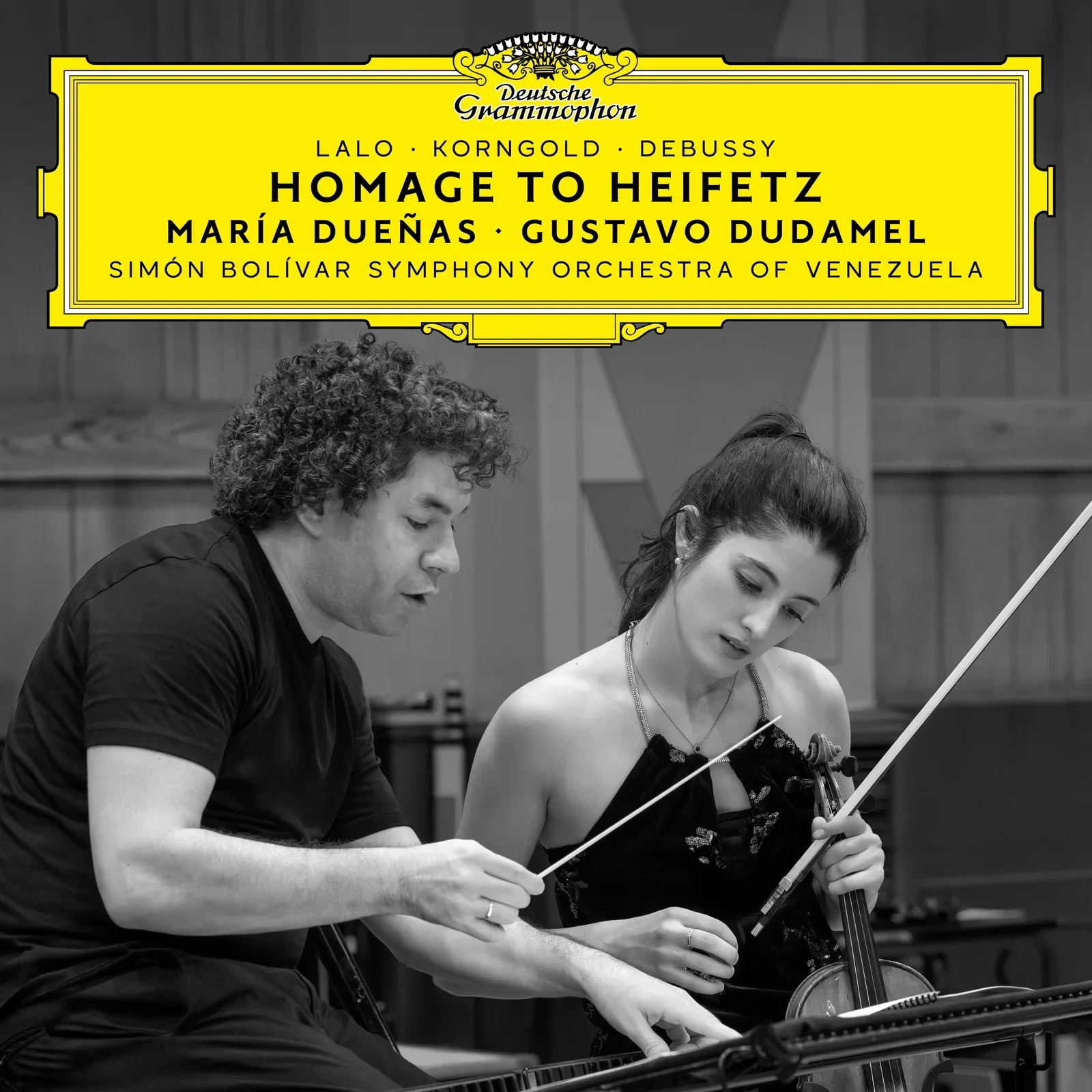
Between 1987 and 1989 the world of classical music lost Vladimir Horowitz and Jascha Heifetz, icons of the piano and violin. Their storied careers have inspired generations of musicians such as Spanish violinist María Dueñas who teams up with current phenomenon Gustavo Dudamel and the Simón Bolívar Symphony Orchestra of Venezuela in a recent album, Homage to Heifetz (Deutsche Grammophon, 2026). The album features some signature pieces Heifetz performed such as Erich Wolfgang Korngold’s violin concerto. Op. 35, Édouard Lalo’s Symphonie espagnole, Op. 21 and shorter works of Claude Debussy and Manuel Ponce for violin and piano.
Korngold, like Heifetz was an ultimate child prodigy, having composed Der Schneemann (The Snowman) at age eleven and the opera Die tote Stadt (The Dead City) twelve years later. Of course, he is credited with many successful film scores such as the classic The Adventures of Robin Hood (1937). Heifetz premiered Korngold’s violin concert with the St. Louis Symphony in 1947 and six years later recorded it with the Los Angeles Philharmonic. Despite some sketchy reviews at its debut, the work remains an esoteric part of concerto repertoire for violinists.
There is an elusive element to Korngold’s writing that makes his music intriguing, old school and far-reaching, of which Dueñas captures with an essence of fleet, sparkling articulation in the Finale and dreamy tonal quality in the Romance. At only twenty-three years old, she already has a global career that sprouted after winning numerous competitions including the Menuhin Competition and Vladimir Spivakov International Violin Competition. Of course, the Heifetz sound, technique and bowing can never be duplicated but this homage album is an awesome way to honor the memory of this late, great violinist as well as hear some classy violin playing. In the album booklet, Dueñas says, “I wanted this recording to portray something of how I grew up with his playing. I believe that remembering where you come from, where everything started, helps keep your feet on the ground. This album is about those values and about a musician who means so much to me.”
Both she and fine young players of the Simón Bolívar Symphony under Dudamel pull out all the stops in Symphonie espagnole, a piece the Spanish virtuoso Pablo de Sarasate premiered in 1875 and Heifetz recorded with the RCA Victor Symphony in 1951. This piece has several snappy themes that keep you humming, and Dueñas offers a personalized interpretation by drawing out a great deal of stylistic drama and emotion in the Andante, as well as zipping up and down the fingerboard with smooth rapidity in the Rondo with its unforgettable rhythmic motive. Did I already mention that she is only twenty-three years old.
The album concludes with several pieces associated with encore treats Heifetz often played, with Dueñas and respected collaborative pianist Itamar Golan now in control. How amazing that she performs these pieces on a violin Heifetz often used, the so-called “Heifetz, Piel Stradivari of c. 1731. In the program notes she says, “Heifetz owned this instrument when he premiered Korngold’s violin concerto…It’s so different from anything I’ve played on before. I approached the recording without having practiced much on this violin…” No worries, as her performance of three Belle Ėpoque inflected pieces has a mellifluous, lilting intimacy and mellow expressivity that is enhanced by her sublime tone in Debussy’s Le fille aux cheveux de lin, (Matthias Spindler arrangement), La plus que lente, (Léon Roques arrangement) and Heifetz arrangements of La chevelure and Ponce’s Estrellita.
Homage to Heifetz provides a look back at Jascha Heifetz and a leap forward to the ongoing career of highly talented violinist Maria Dueñas.